


How people actually arrive
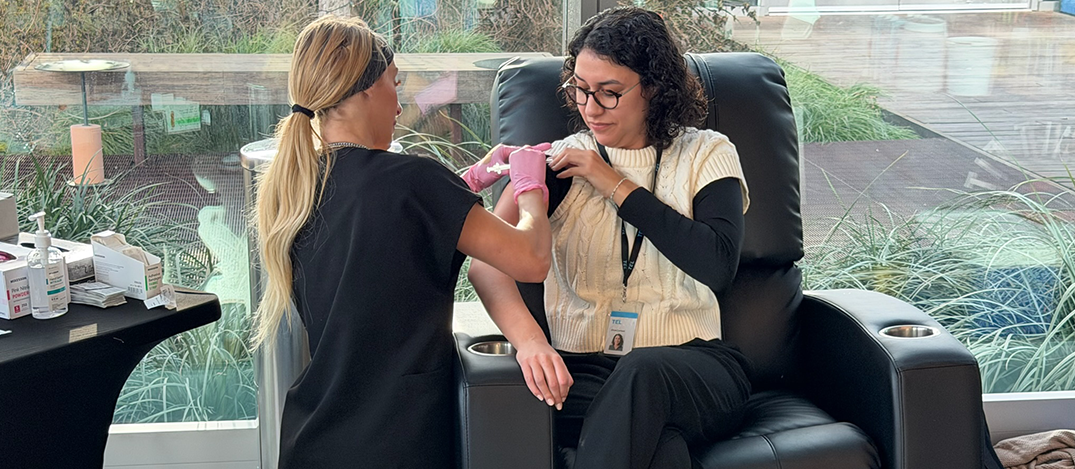
Across nearly every wellness activation we host, arrival looks the same. People come straight from meetings with email still open. Shoulders are up around ears. A few commit immediately, and the rest hover near the edges of the space, weighing whether to participate or observe.
We don't blame them. Most employees have sat through wellness that was a webinar link, a portal login, or a benefits-fair pamphlet. They've learned that "wellness" usually means being told about support rather than feeling any. Caution is a reasonable response to that history.
Before, during, and after
The guarded arrival never lasts, and the shift follows a pattern we could set a watch by.
It starts when the experience gives people something physical to do. The first pair of compression boots gets occupied. Someone sits down for ear seeding mostly to see what it is. Movement begins, and within minutes the room sounds different: conversations soften, someone laughs at a volume they wouldn't use in a conference room, and the person who came to observe is holding a MOOD Bar rollerball asking the practitioner what's in it.
"The hierarchy flattens too. We regularly watch a director and an intern end up in adjacent massage chairs with nothing to do but talk. Those conversations don't happen in meeting rooms, and they are visibly not about work."
Afterward, people linger. That's the tell we trust most. Attendees who arrived checking their phones leave fifteen minutes after their slot ended, mid-conversation. We hear the same sentence at nearly every event: some version of "I didn't know I needed that." We collect formal feedback, but the lingering is the data point that never lies.
Why the perk framing fails
Call wellness a perk and you've quietly told employees it's optional garnish, engaged with only if time and energy allow. The people running on the least energy — the ones who need it most — are exactly the ones who opt out of garnish.
The failure isn't effort or budget. It's design. Wellness that lives in portals and policy documents stays theoretical, and theoretical support has never lowered anyone's shoulders.
Wellness as a perk
Lives in portals and policy documents. Optional garnish for people with energy to spare. Theoretical support that never lowered anyone's shoulders.
Wellness as an experience
Felt in the room, together, on a normal workday. The environment does the convincing — no motivation required from tired people.
What actually changes behavior
Every employee already knows they should manage stress. Knowing hasn't changed how anyone's Tuesday feels.
What changes behavior is direct evidence: ten minutes of guided breathwork that a person can feel dropping their heart rate is an argument no slide deck can make. Once someone has felt the difference, they seek it out again without being reminded — and when they felt it alongside coworkers, participating stops being a personal statement and becomes something the team does.
Direct, physical evidence in the body — not a slide deck, not a pamphlet.
Participating becomes what the team does — not a personal statement made alone.
Once felt, people return without being reminded. The environment builds the habit.
What teams carry back
The outcomes that matter most walk out the door with the attendees. A conversation between two people who'd only ever emailed. The visible proof that leadership sat in the massage chairs too. The discovery that a workday can contain twenty minutes that ask nothing of you.
Those moments keep working after the event ends. They come up in Slack the next day, they lower the barrier for the next hard conversation, and they signal care in a way no benefits announcement can.
A well-designed activation
Becomes a reference point teams talk about for months — a shared experience that keeps lowering barriers long after the event ends.
A portal login
Never is. Theoretical support has no reference point, no shared memory, and no reason to come up in Slack the next morning.
What this means for your next event
The upgrade from perk to experience doesn't require more programming or a louder launch. It requires different design questions.
Instead of "What should we offer?" — ask what people will physically feel.
Ask whether they'll feel it together — or alone, in a browser tab, on their own time.
Ask what they'll still be talking about a week later — not what they'll file away and forget.
Wellness sticks when people feel it in the room, together, on a normal workday. Design for that and you don't have to convince anyone to care. The room does the convincing. The metric that matters isn't how many people showed up — it's how many were different when they left.
Bring experiential wellness to your team
From Recovery Lounges to full wellness event productions — built around what teams actually feel and remember.
Find Your Experience →